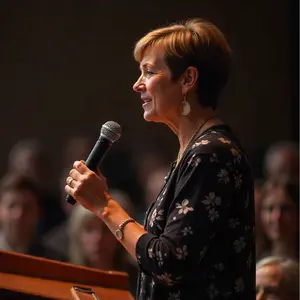
outputGenerated with FuneralSpeechAI using AI
Good afternoon, everyone.
Thank you for being here to remember and celebrate my little sister, Sarah Louise Bennett—Sari to almost all of us—who was born on April 22, 1990, and left us far too soon at 35.
I’m her sister, her closest confidante, and her partner in all our family adventures.
It still feels impossible to fit Sari into a single story.
She was more like a stack of well‑loved books: notes in the margins, dog‑eared corners, sentences underlined because they made something inside you sit up a little straighter.
She grew up in Portland, the daughter of Helen and Mark, who taught us both how to notice the world—how to point out a sky that looked like spilled watercolor, how to save a joke for exactly the right moment.
Sari took that noticing and ran with it.
She studied English at the University of Oregon and came home with a suitcase full of paperbacks and a certainty that language could make people braver.
Then she did what brave people do—she shared it.
She became a middle school teacher and a debate coach, the rare combination of gentle and unflinchingly honest that made her students lean in.
She taught them how to build an argument, yes, but also how to listen all the way through someone else’s sentence.
It’s hard to measure the impact of that, except when you see a kid who used to stare at their shoes lift their head and say, “I have something to add.”
Outside the classroom, Sari had a way of turning “wouldn’t it be nice” into “see you Saturday.”
She organized neighborhood book swaps that spilled from the rec center onto the sidewalk, little stacks of poetry next to mysteries and dog manuals, old paperbacks propped with handwritten notes like, “This one made me miss my bus stop in a good way.”
She coaxed shy readers into conversations and unapologetic readers into lending their favorites.
She helped stitch together community theater productions that could make a roomful of grown‑ups and kids forget what time it was.
Some people volunteer; Sari invited.
There’s a difference.
At home, she was with Jamie—Jamie Rivera, her devoted partner—who made ordinary evenings into their own warm ritual.
There was a rhythm to their weekends: a list scribbled on a receipt, a stop for coffee on the way to the farmer’s market, a debate over which heirloom tomatoes to baby through the season, a shared look that said, “Yes, get the seedlings, we’ll find room.”
Their kitchen bore witness to a lot of burnt toast experiments, impromptu auditions for community theater, and the kind of laughter that knocks the edge off a hard day.
And then there was Sari the auntie—Auntie‑extraordinaire to my two, Nora and Felix.
She was the one who showed up early to school concerts with snacks the size of a carry‑on bag, who remembered the exact knock‑knock joke that made Felix snort, who managed to find dinosaur‑themed bookmarks right when Nora announced “I’m too old for dinosaurs” and then quietly slipped them into her backpack anyway.
She didn’t just love my kids; she loved them in their particularities.
They knew it.
If you ask me what I’ll miss most, it’s the way Sari showed up.
Early and with snacks, sure—somehow with the perfect mix of carrot sticks and contraband gummy bears—but also with that fearless honesty that could recalibrate a room.
She didn’t do the polite nod when truth was needed.
But she also didn’t weaponize the truth.
She had a gift for saying, “Hey, this part’s not working, but look how much is.”
People got braver around her because she was on their side, even when she disagreed.
One of my favorite memories—one I’ve replayed like a favorite song this week—happened in my kitchen at 11 p.m. on a Tuesday.
We were frosting cupcakes for her students’ birthdays—because in Sari’s universe, kids deserved to be celebrated in buttercream—and we had music on, and she kept changing the playlist mid‑whisk.
There we were, elbows dusted with powdered sugar, turning the counter into a small disaster zone, and she starts a dance party with the spatula as a microphone.
She made up new lyrics about attendance sheets and permission slips.
We laughed until our sides hurt.
At one point she looked at the rows of frosted cupcakes and said, “Some of these are going to fall over on the way to school, but honestly, that’s just physics. What matters is they’ll still taste like a good idea.”
That was her approach to everything: perfection was optional; joy was not.
Sari was spiritual in a quiet, resolute way.
She was not religious in the formal sense, but she was fluent in wonder.
She found meaning on slow nature walks where she could identify birds by their chatter and clouds by their intentions.
She kept a small notebook for lines of poetry that surprised her—sometimes her own, sometimes someone else’s, always chosen like seashells, weighed in the palm first.
She believed in reflection without the performance of it.
If you ever walked beside her at the coast, you know she loved the long horizon, the chance to be small in the best possible way.
Community theater was one of her happiest places.
Not because she wanted the spotlight—though she could hold it—but because she loved the rehearsal room, the duct‑taped props, the late night notes from a director scribbled on the backs of old scripts.
She loved watching someone find the line that made their voice ring a little truer.
She cheered loudest for the understudies.
And she was no less herself at a poetry slam, reading a new piece with hands that shook only until the first laugh broke the tension.
She planted tomatoes with the same care she gave to students’ first drafts—staking up the spindly ones, celebrating the stubborn ones, forgiving the ones that split in too much rain.
As a debate coach, she taught kids to disagree without detonation.
If you ever sat in on practice, you’d hear her say, “A strong argument has strong ears.”
I keep thinking how useful that sentence could be in every room we’ll walk into from now on.
It sounds like something this world could use on repeat.
To our parents, Helen and Mark—she was proud to be yours.
She borrowed your best parts and remixed them.
Your patience showed up in her classroom.
Your humor showed up at the exact minute a meeting needed it.
And your love of community became her signature.
To Jamie—thank you for loving her the way you did.
You gave each other a home that had a back door open to the garden and a front door open to friends.
That kind of life takes attention; you both paid attention.
To my kids, Nora and Felix—Auntie Sari adored you beyond measure.
She’d want you to keep asking big questions, to read past your bedtime sometimes, to take snacks to your friends when days feel long.
She’d also remind you to label your water bottles, because Auntie Sari valued a good system.
For all of us, grief is doing what grief does—arriving in waves, surprising us in the cereal aisle, loosening its grip when a memory makes us laugh out loud.
There’s no shortcut.
But we are not empty‑handed.
Sari left us tools: curiosity, loyalty, encouragement that is specific and not vague, honesty that is kind and not performative, and the stubborn habit of turning ordinary moments into celebrations.
We can use those tools on each other.
And because she was always thinking of what could last, Sari asked—in lieu of flowers—that we support the school library fund she cared about so fiercely.
It makes sense that she’d want stories to keep traveling, spines cracked, pages smudged with fingerprints.
Today, we’re also setting out some of her favorite books for anyone to take home.
Please do.
Write your name in the front.
Underline a sentence.
Pass it along when you’re ready.
Make her library a moving thing.
If you’re looking for a way to honor her in the days ahead, you don’t have to build a theater or start a program.
Try what she tried.
Take a walk and actually look.
Show up early—with snacks.
Nudge a quiet kid to share an idea.
Say the honest thing, and say it with care.
Start a tiny celebration in the middle of an ordinary Tuesday.
We will keep telling Sari stories—about the time she read a student’s debate case on the bus and missed her stop because the conclusion took her by surprise; about the summer she planted more tomatoes than the yard could handle and started leaving them on neighbors’ porches with notes that said “Recipe suggestions available upon request”; about the kitchen dance parties that extended the life of cupcakes and people alike.
Sari, my sister, thank you for every late‑night call, every “you’ve got this” text sent at the exact right minute, for refusing to let cynicism win, for believing that teenagers could change a room if adults would only give them the floor.
Thank you for the courage you lent me without keeping score.
We didn’t get enough time.
No one here thinks we did.
But the time we got was full.
You filled it.
You pushed more chairs around the table and made room.
We will carry you with us—in classrooms and living rooms, in gardens and rehearsal halls, in the tiny pause before we answer, in the good kind of mess left by generosity.
We will try to live a little more like you did: curious, loyal, honest, and ready to turn up the music even when the hour is late.
We love you, Sari.
We always will.