Clicky

Eulogy for Grandmother from Granddaughter (3 Examples)

👵👧 Eulogy for Grandmother from Granddaughter (3 Examples)

341 speeches created in the last 30 days

Find here eulogies for grandmother written by granddaughter. The grandmother-granddaughter relationship is filled with special traditions and wisdom. These examples of eulogies for grandmother from granddaughter help capture the unique bond and celebrate the lasting impact of a beloved grandmother.

Eulogy 1 Eulogy 2 Eulogy 3

Eulogy for Grandmother from Granddaughter Examples

input
  • Birth date and age at death: Born March 5, 1939, passed at age 86
  • career_passions: Elementary school librarian who inspired a love of reading; passionate about community literacy programs
  • What special character traits defined this person?: Gentle, steadfast, witty, and remarkably patient; had a way of making everyone feel heard
  • comforting_words: She often said, 'Be kind, for everyone you meet is fighting a hard battle,' and reminded us that love leaves a light on
  • Name of the deceased: Eleanor Grace Bennett
  • How long should the eulogy be?: Medium (4-5 minutes)
  • What role did faith/spirituality play in their life?: Devout Christian who led the church book circle and found strength in prayer
  • Family and loved ones (spouse, children, grandchildren, etc.): Married to Arthur for 61 years, mother of three, grandmother to six
  • What is your favorite memory of the deceased?: Baking peach cobbler together on summer afternoons while she told family stories
  • How formal should the language be?: Personal/Informal
  • What hobbies, interests, or passions did they have?: Gardening, knitting blankets for new babies at church, birdwatching, and crossword puzzles
  • I am the...: Grandchild
  • Brief life story - important milestones: Grew up in Savannah, Georgia; married her high school sweetheart; moved to North Carolina where she built a close-knit home filled with faith and hospitality
  • Nickname or what they were lovingly called: Nana Ellie
  • Describe your relationship to the deceased: I am her granddaughter; she helped raise me and was my safe place
  • What type of service will this eulogy be given at?: Funeral Service
  • What tone should the eulogy have?: Comforting
  • What will people miss most about this person?: Her warm hugs, her quiet wisdom, and the way her laughter filled the kitchen

outputGenerated with FuneralSpeechAI using AI

Good morning, everyone. Thank you for being here to honor the life of my grandmother, Eleanor Grace Bennett—our beloved Nana Ellie. She was born on March 5, 1939, and at 86 she went home with the same quiet grace with which she lived. If you knew her, you knew warmth and steadiness—gentle hands, patient eyes, and a wit that could lift a heavy day just enough to let the light in. I am her granddaughter. She helped raise me. She was the place I went when the world felt too loud—the person who could hear what I was trying to say, even when I couldn’t quite say it. Being with her felt like sitting in a room where the lamp is always on and the kettle is already warming. She grew up in Savannah, Georgia, where magnolias and front-porch conversations shaped her love of hospitality. She married her high school sweetheart, Arthur, and for 61 years they built a life together in North Carolina—a home that was close-knit, faith-filled, and open to anyone who needed a chair at the table. They raised three children, and somehow she found a way to be fully present for six grandkids, including me. Professionally, she was an elementary school librarian, and I don’t think it’s an exaggeration to say she changed the arc of many little lives. She didn’t just shelve books—she opened doors. She had a gift for matching a hesitant reader with the exact story that would make their eyes widen and their shoulders lift. And she didn’t stop at school. She poured herself into community literacy programs, believing that reading is both refuge and launchpad—a way to be safe and a way to become brave. Her faith was the steady heartbeat underneath it all. A devout Christian, she led the church book circle, prayed with the same sincerity in her kitchen as she did in a pew, and taught us—without sermon—how to find strength in prayer. If you spent five minutes with her, you felt that her faith wasn’t a performance. It was a quiet anchor. She had hobbies that felt like extensions of her heart. She knitted soft blankets for new babies at church, welcoming them to a world she hoped would be gentle. She tended her garden with patience, delighted in the birds that visited, and waged playful war against the Saturday crossword. And then there was the kitchen—the place where her laughter knitted the family together. My favorite memories are summer afternoons, the two of us making peach cobbler. She’d show me how to fold the batter, how to listen for the whisper of boiling fruit, and while we worked, she told stories—little legends of our family. Somehow, as the kitchen filled with cinnamon and sunlight, I learned where I came from and who I could be. She never rushed the moment. She didn’t just teach me recipes; she taught me a way of being—slow enough to notice, loving enough to remember. She had signature wisdom. She would say, “Be kind, for everyone you meet is fighting a hard battle.” And then she’d add her own benediction: love leaves a light on. If you’ve ever felt that it was easy to talk to her, to cry with her, or to simply be quiet beside her, that’s it—that’s the light she left on for us. What will we miss most? Her warm hugs—the kind that told you before words did that you were safe. Her quiet wisdom—the way she could ask one gentle question and suddenly your problem had edges you could hold. And her laughter in the kitchen—how it rose like steam and made everything smell like hope. To Arthur—Granddad—thank you for loving her so faithfully for 61 years. You showed us what steadfast looks like, day after day. To her three children—who carry her strength and her humor—and to us six grandchildren—who carry her stories—please know that the best parts of us were shaped by the best parts of her. If you ever wondered how she did it—how she held so many people and tasks and worries at once—here’s what I think. She listened. She waited for the right word. She found a way to make room—at the table, on the bookshelf, in her schedule, in her heart. Savannah gave her roots. North Carolina gave her a home. Her faith gave her courage. And love gave her purpose. Today is heavy—of course it is. But it is also, in the way she taught us, a day to be grateful. Grateful for a librarian who believed stories could unlock a life. Grateful for a gardener who knew beauty requires tending. Grateful for a grandmother who somehow remembered every birthday, every favorite cookie, every quiet prayer we never told anyone else. If you are looking for her legacy, it’s easy to find. It’s in the children who learned to read because she believed they could. It’s in the blankets wrapped around newborns—tiny lives warmed by patient hands. It’s in the gardens that will bloom this spring because she taught us when to prune and when to let things grow. It’s in each of us, passing along her small acts of kindness as if they were family heirlooms. She often reminded me: love leaves a light on. And I believe it. I see that light in Granddad’s eyes. I hear it in the laughter that still echoes from her kitchen. I feel it when we hold each other a little longer than usual, because she taught us to do that. So we will grieve—because love makes room for grief. And we will celebrate—because love also makes room for joy. We’ll make cobbler in the summer and tell her stories until the cinnamon reaches the hallway. We’ll read to our children and to anyone who needs to be read to. We’ll lead with gentleness, practice patience, and be just witty enough to soften a hard day. Nana Ellie, thank you—for every prayer, every book, every soft blanket, every garden row, every answered phone call, every hug that sent us back into the world braver than we arrived. We love you. We will miss you. And we will carry your light forward, one kind act at a time, until we’re home and the door is already open, and the light is still on.

input
  • Birth date and age at death: Born November 22, 1934, passed at age 89
  • career_passions: Dedicated nurse renowned for compassionate care; advocate for end-of-life dignity
  • What special character traits defined this person?: Dignified, principled, compassionate, with a gentle sense of humor
  • comforting_words: She loved the line, 'The Lord is my shepherd; I shall not want,' and often said, 'Do the next kind thing'
  • Name of the deceased: Margaret Louise Carter
  • How long should the eulogy be?: Short (2-3 minutes)
  • What role did faith/spirituality play in their life?: Held a quiet, steadfast faith; found solace in hymns and evening prayer
  • Family and loved ones (spouse, children, grandchildren, etc.): Widow of Thomas, mother of two sons, grandmother of four
  • What is your favorite memory of the deceased?: Walking along the harbor at sunrise with hot cocoa, listening to her life lessons
  • How formal should the language be?: Formal
  • What hobbies, interests, or passions did they have?: Classical music, watercolor painting, and tending roses
  • I am the...: Grandchild
  • Brief life story - important milestones: Born in Boston, studied nursing, served as a head nurse for two decades, later volunteered extensively at hospice
  • Nickname or what they were lovingly called: Grandma Peggy
  • Describe your relationship to the deceased: Granddaughter who spent every summer holiday at her home
  • What type of service will this eulogy be given at?: Memorial Service
  • What tone should the eulogy have?: Balanced
  • What will people miss most about this person?: Her calming presence, precise advice, and handwritten birthday letters

outputGenerated with FuneralSpeechAI using AI

Family and friends, thank you for being here to honor the life of my grandmother, Margaret Louise Carter—our beloved Grandma Peggy. She was born in Boston on November 22, 1934, and in her 89 years she lived with quiet dignity and a steady, generous heart. She studied nursing and became a head nurse for two decades, known for compassionate care and precise wisdom. Later, she poured that same devotion into volunteering at hospice, standing beside families at the most fragile thresholds and advocating fiercely for end-of-life dignity. She believed that how we care for one another—especially at the end—says everything about who we are. She was the widow of Thomas, the proud mother of two sons, and the delighted grandmother of four. To us, she was a calming presence, a principled guide, and, always, the one who added a gentle glint of humor when we needed it most. “Do the next kind thing,” she liked to say. It was never just a phrase. It was her way of moving through the world. Every summer of my childhood, I lived in the rhythm of her home. My favorite memory is simple and sacred: walking the harbor at sunrise, hands wrapped around hot cocoa, listening as she shared life lessons in that calm, steady voice. The gulls, the light on the water, the quiet of the early hour—she made it feel like the day was opening just for us. She never lectured. She offered wisdom the way she did everything else: gently, respectfully, with a smile. Her life was also full of beauty she created and tended—classical music playing softly in the background, watercolor landscapes drying on the kitchen table, and roses carefully pruned until they seemed to glow. She showed me that discipline and tenderness can coexist—that strong back, soft front, and wild heart are not opposites but companions. Her faith was quiet and steadfast. She found solace in hymns and evening prayer, and she loved to recite, “The Lord is my shepherd; I shall not want.” In times of uncertainty, that line steadied her; in times of grief, it steadies us now. What we will miss most are the small, indelible signatures of her love: the handwritten birthday letters—each one exact, warm, and tailored to the person; the way she listened fully before offering guidance; the gentle laughter that let us know we were safe. If you sought clarity, she gave you precise advice. If you needed courage, she stood beside you until you found it yourself. Today, we remember a nurse who cared deeply, a volunteer who stayed late, a mother and grandmother who showed up unfailingly, and a woman whose dignity never dimmed her compassion or her humor. We grieve, but we also give thanks. Her legacy isn’t an idea we have to invent; it’s a practice we can continue. When we are unsure, we can do the next kind thing. When we are hurried, we can slow down and listen. When we are afraid, we can take a sunrise walk, breathe, and remember the steady hand that once held ours. Grandma Peggy, you taught us to love well, to stand on principle, and to meet the world with gentleness. Your roses will bloom again this spring, your music will play in our kitchens, and your letters—kept in drawers and memory boxes—will guide us for years to come. Thank you for the summers, the stories, the service, and the grace. We will carry your light forward, one kind thing at a time. Rest in peace, and rest in God’s keeping.

input
  • Birth date and age at death: Born July 14, 1942, passed at age 82
  • career_passions: Small business owner and baker known for her cinnamon rolls; organized charity bake sales for local shelters
  • What special character traits defined this person?: Vibrant, generous, adventurous, and fiercely loyal to family
  • comforting_words: She’d wink and say, 'Life is sweet—taste every bite,' and remind us to 'leave a place better than you found it'
  • Name of the deceased: Dorothy Ann Mitchell
  • How long should the eulogy be?: Longer (6+ minutes)
  • What role did faith/spirituality play in their life?: Spiritual in a heartfelt, inclusive way; believed in gratitude and daily blessings
  • Family and loved ones (spouse, children, grandchildren, etc.): Married to Harold for 48 years, mother to one daughter and one son, grandmother of five, great-grandmother of one
  • What is your favorite memory of the deceased?: Dancing in the kitchen to old records while the dough rose, laughing until we cried
  • How formal should the language be?: Personal/Informal
  • What hobbies, interests, or passions did they have?: Traveling by train, photography, jam-making, and community theater
  • I am the...: Grandchild
  • Brief life story - important milestones: Raised in a small Iowa town; started a local bakery that became a community staple; retired to spend more time traveling with friends
  • Nickname or what they were lovingly called: Grandma Dot
  • Describe your relationship to the deceased: Her granddaughter and Saturday-morning market buddy
  • What type of service will this eulogy be given at?: Celebration of Life
  • What tone should the eulogy have?: Celebratory
  • What will people miss most about this person?: Her spontaneous road trips, bear hugs, and the way she turned ordinary days into celebrations

outputGenerated with FuneralSpeechAI using AI

Good afternoon, everyone. Thank you for being here to celebrate the life of my grandmother, our beloved Dorothy Ann Mitchell—though to most of us, she will always be Grandma Dot. She was born on July 14, 1942, raised in a small Iowa town where the streets were a little quieter, the stars a little brighter, and neighbors still waved from their porches. That town gave her roots—sturdy ones—and she built a beautiful life from them. She married her partner in everything, Harold, and for 48 years they showed us what devotion looks like in daily practice. Together they raised a daughter and a son, and the family tree kept growing—five grandchildren, and one lucky great-grandchild who already has a legacy of love wrapped around them like a quilt. Many of you knew Grandma first by her cinnamon rolls. Yes, those cinnamon rolls. The kind that made grown adults plan their Saturday mornings with military precision. She took a simple dream—a small local bakery—and kneaded it into a community staple. People came for the pastries, but they stayed for the way she remembered their names, the way she cut an extra generous corner piece for anyone who looked like they’d had a rough week. And when there was a need in town, she organized charity bake sales for local shelters, making sugar and spice serve something bigger than themselves. If you ever wondered what kindness smells like, it smells like her kitchen before sunrise. When she retired, it wasn’t to slow down. She traded bakery hours for train schedules and maps dog-eared at the corners. She traveled with friends, collecting stories the way some people collect figurines—set on windowsills of conversation, brought out to catch the light when you sat with her over coffee. Her camera was always ready, her bag always half-packed, and her heart always open to wherever the tracks might lead next. If I had to choose the thread that ran through everything she did, I’d say she was vibrant, generous, adventurous, and fiercely loyal to family. Fiercely loyal. She showed up—at recitals and graduations, for casseroles after tough news, for quick hugs in parking lots, and for celebrations that she sometimes invented out of thin air just because a Tuesday felt too ordinary. She was the rare kind of person who could build a crowd out of three people and a record player. I was lucky enough to be her granddaughter and her Saturday-morning market buddy. We had a ritual: coffee in hand, a list we never followed, and the unspoken rule that berries taste better when you sneak one before you buy them. My favorite memory is the one that plays in my mind like a film I never want to end—us dancing in the kitchen to old records while the dough rose, laughing until we cried. She’d point at the timer, say “We’ve got three songs,” and then we’d spin on the tiles, our socks slippery, flour in the air like confetti. If joy had a soundtrack, it was the hiss of a record and the thump of our heels on her kitchen floor. Grandma’s faith was a gentle, steady flame. She was spiritual in a heartfelt, inclusive way—no gates, no guardrails, just a daily practice of gratitude and noticing blessings. She taught me to look for them everywhere: in the steam on a winter window, in the kindness of a stranger, in a loaf that rose better than you expected. She’d bow her head over a meal and say, “Thank you for what we have, and for what we have to give.” Then she’d look up and mean it with her whole face. She wasn’t just a baker. She was a maker—of jam that tasted like August, of photographs that caught someone’s true smile, of costumes for community theater when they were short a seamstress. She loved traveling by train because it let her watch the world without rushing past it, and she loved theater because it gave people permission to be larger than life. But my favorite of all her roles was “instigator of joy.” She had a gift for turning an ordinary day into a celebration—a paper crown at breakfast, a candle in a Tuesday muffin, a spontaneous road trip to see the sunflowers because somebody needed cheering up. Those are the things we’ll miss most: her unscripted adventures, her bear hugs that squeezed out the worry, and the way she could spot the celebration hidden inside any day. She had sayings—her own little philosophies—that we’ll keep hearing long after today. She’d wink and say, “Life is sweet—taste every bite,” whenever someone hesitated to try something new. And she’d remind us, “Leave a place better than you found it.” She lived those words. She left the bakery better than she found it, the shelters better resourced than they would have been without her, and every room better simply because she walked into it smiling and left behind a little trail of laughter. Family came first, last, and in between. She was the grandmother who could be all things at once—soft shoulder, fierce defender, honest advisor, and secret-keeping co-conspirator. She was the one who texted to check if you’d eaten, showed up with jam “by accident,” and slipped you ten dollars in market tokens even though you already had a pocket full. She believed that love is a verb, and she practiced it daily. When I think about the arc of her life—from that small Iowa town, to the bustling bakery, to trains clicking across new landscapes—I see the same woman at every stage: brave in her way, generous with what she had, and endlessly curious. The milestones matter—starting a business that became a home base for a whole community, organizing bake sales that turned sugar into shelter, retiring not from purpose but toward exploration—but the measure of her life is also in the smaller, quieter proofs: warm rolls pressed into waiting hands, a camera pointed toward your best angle, a seat saved for you at the table even when you weren’t sure you deserved it. To Harold—Grandpa—thank you for 48 years of love that taught us what partnership looks like when it’s real. To her daughter and son—thank you for sharing your mom with so many of us, for letting her become everyone’s “Grandma Dot.” To my cousins, to our little great-grandbaby—her love is yours to keep, and it reproduces every time you share it. That’s the math she lived by. Grief is heavy today. It should be. But this is a Celebration of Life, and if we listen carefully, she’s still helping us plan it. I can hear her now, utterly herself: Put on the record. Pour the coffee. Take the picture. Pack the bag. Taste the berries. Hug like you mean it. She taught us how to show up for one another. So let’s honor her by doing just that—by checking on neighbors, by buying from the small shops that keep a town alive, by passing a plate across the table with a few extra baked too long on purpose because someone always likes the corner piece. Let’s organize another bake sale when the shelter needs blankets. Let’s make jam in July and label the jars with jokes. Let’s hop a train just because the map looks interesting. Let’s leave every place better than we found it. I believe she’d want us to remember that gratitude is a practice, not a mood. That adventure can be as close as the kitchen floor. That a community can be built from flour, sugar, yeast, and a little elbow grease—if you add generosity and turn the music up while it rises. Grandma, thank you. For the cinnamon rolls and the courage. For the charity tables and the train tickets. For being vibrant when the world felt gray, generous when the world felt scarce, adventurous when the world felt small, and fiercely loyal when someone needed a champion. Thank you for choosing joy and inviting us along. We will miss your spontaneous road trips, your bear hugs, and your gift for turning ordinary days into celebrations. But the celebration doesn’t end here. It continues in the way we live, the way we love, and the way we taste every bite of this sweet, precious life. So here’s our promise to you, Grandma Dot: We’ll keep dancing in the kitchen while the dough rises. We’ll laugh until we cry. We’ll take care of each other. We’ll pass on your sayings to the next little ones who toddle into the bakery of our lives and ask for something warm. And when we gather—at markets, at porches, at long tables with mismatched chairs—we’ll save you a seat in the stories we tell. Because you’re in every good story we know how to tell. Life is sweet, you always said. Today it is sweet and salted with tears. Thank you for teaching us to taste every bite. We love you, Grandma Dot. Travel well. We’ll meet you at the next stop, where the coffee is hot, the light is kind, and the music’s already playing.

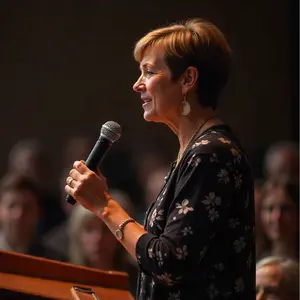
How to write a eulogy for your grandmother as her granddaughter

What to include

On the day

Frequently Asked Questions

Is a granddaughter often asked to give the eulogy?
Yes, especially when the bond was particularly close. Families lean into the voice that knew her in her warmest moments.
Should I read one of her recipes or letters?
If you have one, yes. A line from her own handwriting in your own voice is sometimes the strongest moment of the day.
Can I bring something of hers with me?
A handkerchief, a small piece of jewellery, a card she sent you. Hold it while you read. It steadies you and tells the room who she was.
What if my mum or aunt also wants to speak?
Talk first and divide the territory. The granddaughter angle is yours. Their angle is theirs. The combined picture is what the room remembers.

What FuneralSpeechAI does

You

  • Answer a few simple questions
  • About special moments
  • All answers are optional

FuneralSpeechAI

  • Creates your speech with our AI
  • Personalized based on your answers
  • In an appropriate style
  • Ready in just 10 minutes
One revision by us included

How it works

1

Personal Details

Name, role, style, and length of the speech. The foundation we build on.

2

Answer Questions

You give us the anecdotes and special moments. Our AI turns them into the perfect speech.

3

Order Speech

First the preview, then your decision. One free revision included.

Ready for the perfect Eulogy?

Create a professional and personal Eulogy in just minutes.